Industrial Resilience Starts with Decarbonized Generators
December 17, 2025
India’s manufacturing hubs—from auto clusters in Chennai and Pune to F&B giants in Gujarat and pharma in Hyderabad—run 24/7 on captive power, with 500,000+ diesel gensets (250-2000 kVA) as lifelines against 8-10 hour daily grid outages. Carbon buildup from low-load running (30-50% during off-peaks), sulfur-rich HSD (350 ppm), and wet stacking in humid plants chokes injectors, turbos, and exhaust manifolds, wasting 10-15% diesel and causing 25% of blackstarts to fail—triggering ₹5-20 lakh/hour production halts. Regular engine decarbonization dissolves these deposits via hydrogen cleaning or chemical flushes, cutting fuel use 10-12%, slashing faults by 40%, and ensuring zero-loss backups, as seen in F&B plants logging uninterrupted runs.
Decarbonization hardens industrial spines, powering Industrial Resilience Starts with Decarbonized Generators—clean gensets keep assembly lines humming, profits flowing.
Genset Graveyards in Factories
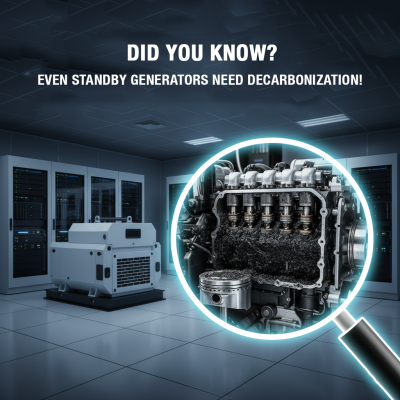
Manufacturing gensets suffer uniquely: idling on partial loads builds unburnt hydrocarbons into sludge, monsoons flood air intakes accelerating corrosion, and biodiesel mandates gum valves. Result: wet stacking dilutes lube oil, DPFs blind prematurely, and NOx spikes fail CPCB stack tests. Per CII data, genset failures cause 30% of ₹12,000 crore annual downtime in SMEs; F&B alone loses ₹2,000 crore to spoiled batches.
Decarbon Blueprint for Plant Powerhouses
Factory-optimized flow:
Load Bank Audit: Simulates full draw to expose 12-18% efficiency gaps.
Hydrogen Flush: On-site plasma (60 mins) vaporizes carbon, no disassembly.
Recommission: Governor tweaks + oil refresh sustain gains for 5,000 hours.
Depot pricing ₹25-40k/set; ROI in 1-2 months at ₹95/liter HSD.
|
Metric
|
Carboned Genset
|
Post-Decarb
|
Gain
|
|---|---|---|---|
|
Fuel Consumption
|
220 g/kWh
|
195 g/kWh
|
-11%
|
|
Fault Rate/Year
|
6-8
|
3-5
|
-40%
|
|
Blackstart Success
|
75%
|
98%
|
+31%
|
|
Monthly Savings (500 kVA, 300 hrs)
|
Baseline
|
₹1.8 lakh
|
+OPEX 15%
|
Tech Locked for 24/7 Duty
Decarb revives:
- Combustion Clean: 20% finer atomization drops smoke 35%.
- Turbo Health: Frees actuators for instant ramp-up.
- Lube Protection: Ends dilution, doubling intervals.
Vs. competitors:
|
Method
|
Cost/Set
|
Fuel Savings
|
Uptime Boost
|
|---|---|---|---|
|
Hydrogen
|
₹35k
|
10-12%
|
15-20%
|
|
Chemical
|
₹28k
|
8-10%
|
10-15%
|
|
Major Overhaul
|
₹2L+
|
15%
|
20%
|
Dominates injectors (fleeting 6%).
Regs & Efficiency Rockets
CPCB’s 2026 genset norms cap PM at 20mg/Nm³; decarb complies cheaply. PLI energy efficiency grants (20%) target plants. CO2 cut: 8 tons/set/year aids RE100 pledges.
Plant Pain Points Solved
Worries: 10-14 month efficacy with semis; dyno-backed.
Scale: Skid rigs for multi-set bays.
OPEX: 4-hr tech certs via MSME.
By 2030, amid $1T manufacturing, decarb frees ₹15,000 crore.
Power your plant’s resilience—see factory stories and toolkits on our energy efficiency resource page, with load curves, emission strips, and CII benchmarks.