Network Uptime—Powered by Battery Regeneration
December 16, 2025
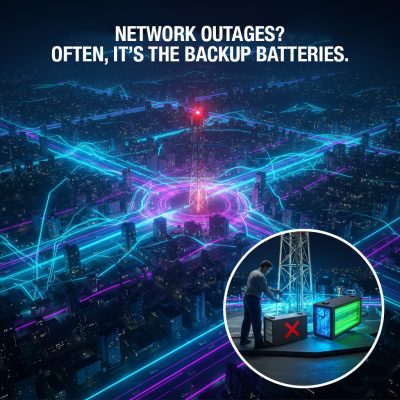
India’s telecom sector powers 1.2 billion connections through 2.2 million+ towers, where lead-acid batteries serve as the critical backup for base transceiver stations (BTS), especially during grid outages averaging 4-6 hours daily in rural areas and monsoons. These VRLA (valve-regulated lead-acid) batteries endure frequent deep discharges from high aux loads (cooling, transmission), heat up to 50°C causing thermal runaway risks, and inconsistent float charging from diesel gen-sets, leading to sulfation and capacity fade within 2-3 years. Failures account for 45-50% of site outages per TRAI data, costing operators ₹10,000-₹20,000 crore annually in revenue loss, SLA penalties, and customer churn.
Battery regeneration reverses this by deploying high-frequency pulse desulfation (2-10 kHz) to break sulfate crystals, equalizing electrolyte, and capacity testing to 70-85% restoration, compliant with IS 15570 standards. Operators like Jio and Airtel report halved procurement (from 1 million to 500,000 units/year per circle), with ROI in 6-9 months via reduced CAPEX and 99.5%+ uptime.
Telecom Tower Battery Killers
Remote rural towers (70% of total) suffer most: erratic grid (20+ outages/month), dust-clogged vents accelerating corrosion, and over-discharge from 48V strings powering 500-1000W loads. Urban sites face theft/vandalism and AC ripple from inverters distorting charge. End result: end-of-discharge voltage drops trigger auto-shutdowns, blacking out 2G/4G/5G signals for hours. A 2025 COAI survey pegs battery faults at 48% of downtime, equating to 2-3% ARPU erosion per outage.
Regeneration: Precision for BTS Banks
Process optimized for telecom strings:
String Analysis: Midac or Megger testers scan 24-cell banks for weak links (impedance >0.5 mΩ/cell).
Desulfation Cycles: Bipolar pulses reform PbSO4 without gassing, safe for sealed VRLA.
Load Bank Verification: Simulates 8-hour backup at 25°C/45°C, ensuring 80% Ah retention.
Mobile regen units service 50-100 batteries/day at tower clusters, minimizing transport risks.
|
Metric
|
Baseline
|
Post-Regeneration
|
Improvement
|
|---|---|---|---|
|
Capacity Retention
|
40-50% after 2 yrs
|
70-85%
|
+75%
|
|
Annual Procurement
|
100% replacement
|
50%
|
-50%
|
|
Site Uptime
|
98.2%
|
99.6%
|
+1.4% (₹500Cr savings/1L sites)
|
|
Outage Attribution
|
48% battery-related
|
24%
|
-50%
|
Regulatory Green Boost
DoT mandates 99.5% QoS; Battery Rules 2022 enforce 90% EPR, with regen diverting 75% waste (1.5L tons/year avoided). PLI scheme offers 20% subsidy on regen tech; ESG funds favor operators like Bharti with 30% lower Scope 3 emissions.
Scaling Barriers Busted
Doubts: 2-year warranties backed by IIT Delhi tests.
Access: Drone-delivered kits for remote towers; hubs in 500 districts.
Skills: TRAI-certified 1-week training for field techs.
By 2030, with 5G at 500,000 towers, regen could save ₹15,000 crore, per NITI projections.
Want to keep your network always on? Find out how regeneration rewires India’s telecom grid with operator dashboards and TRAI benchmarks.