How Forklift Battery Regeneration Cuts Operating Costs by 35% in 6 Months
October 22, 2025
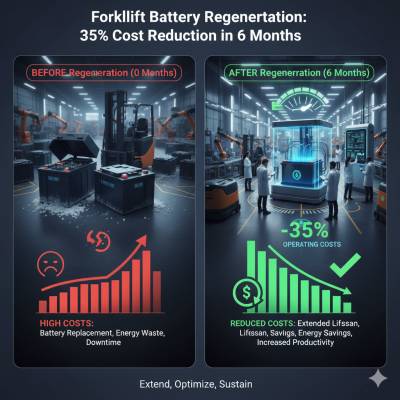
Battery replacement is a hidden cost-driver in most manufacturing and warehouse operations—often responsible for 20–40% of overall forklift fleet OPEX. Yet most companies keep replacing batteries on a fixed schedule or when sudden failures halt operations.
But in 2025, manufacturing leaders are turning to battery regeneration to break this cycle. Let’s look at the numbers and the operational impact.
What Causes Premature Forklift Battery Failure?
-
Deep-cycling beyond recommended thresholds
-
Chronic under- or over-charging by busy operators
-
Proliferation of sulfation on plates (especially in lead-acid models)
-
Extreme operating temperatures and high utilization rates
What Is Battery Regeneration and Why Now?
Regeneration uses algorithmically controlled electrical pulses to break up sulfate crystals or rebalance lithium chemistries, restoring as much as 70–95% of lost capacity. These non-destructive cycles allow batteries to re-enter service and avoid landfill, at a fraction of the replacement cost.
Case Data: Real-World Savings in Manufacturing
A UAE manufacturing plant with a 60-unit electric forklift fleet ran a 6-month regeneration program
Battery replacement frequency fell from every 20 months to every 51 months
Annual OPEX for batteries fell by 35%
Number of unplanned forklift downtimes dropped by 42%
Carbon emissions from battery sourcing and disposal fell by 28%
Technology Advances in 2025
Modern lithium batteries boast 3x the energy density and much lighter weight versus legacy designs. Built-in smart BMS (battery management systems) and IoT sensors allow operators to monitor state-of-health and receive predictive maintenance alerts—enabling targeted regen cycles before catastrophic failure
The Environmental and Regulatory Angle
-
High material recyclability: New lithium batteries designed to be 95% recyclable.
-
Emission-free operation: Indoor air quality improves as battery disposal is reduced.
-
Compliance: Regeneration services support ESG and local environmental requirements, future-proofing supply chains.
Operational Blueprint: Implementing Regeneration
Run baseline fleet diagnostics.
Schedule regeneration for batteries at 60–80% SOH.
Adopt smart charging and operator training for life extension.
Use digital records to track every battery lifecycle and regen event for ROI proof.
Conclusion
Battery regeneration is a no-brainer for manufacturing and material handling operations aiming to cut costs, improve uptime, and achieve sustainability KPIs. With global forklift battery demand set to double by 2034, those optimizing battery life now will define the next decade of industrial productivity.
Where do you see the quickest win in your own battery operations?