Unlocking the True Value of Forklift Fleets
December 15, 2025
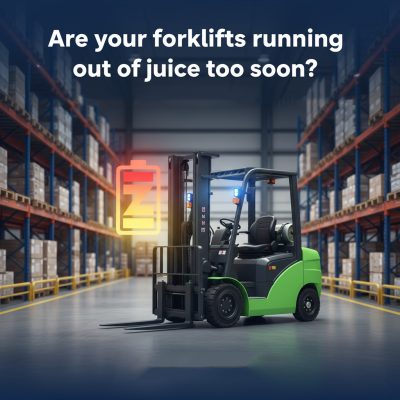
Indian manufacturing is undergoing a silent transformation, and at its heart lies a critical yet often overlooked asset: the electric forklift battery. With over 1.5 lakh electric forklifts powering warehouses, factories, and assembly lines across the country, these workhorses move billions in goods annually. However, a staggering reality persists—battery replacement costs account for up to 70% of total forklift fleet operating expenses over a 5-year lifecycle. Industry estimates suggest India generates over 60,000 dead forklift batteries each year, most discarded prematurely when they still retain 60-75% recoverable capacity.
The Battery Degradation Crisis
Forklift batteries face brutal operating conditions: 24/7 high-cycle usage, extreme summer temperatures exceeding 45°C, inconsistent charging practices by overworked operators, and chronic sulfation that hardens lead plates or imbalances lithium cells. Lead-acid batteries, still dominant at 65% market share, suffer most from sulfate crystal buildup, while newer lithium-ion models (growing at 28% CAGR) face thermal runaway risks and BMS (Battery Management System) failures. The result? Premature capacity loss—batteries dropping below 80% health after just 12-18 months, triggering expensive replacements costing ₹3-5 lakh per unit.
Enter Battery Regeneration: Science Meets Savings
Battery regeneration isn’t a gimmick—it’s advanced electrochemistry. The process begins with comprehensive diagnostics using impedance spectroscopy and capacity testing to identify failure modes. For lead-acid batteries, pulsed desulfation technology applies high-frequency electrical impulses (typically 1-10 kHz) to shatter sulfate crystals without damaging plates. Lithium cells undergo precision rebalancing, equalizing individual cell voltages to restore pack-level performance. Post-regeneration testing confirms 70-95% capacity recovery, certified against ISO 12405 standards.
Real-World Manufacturing Impact
Consider a leading auto-ancillary plant in Pune with a 120-forklift fleet. Pre-regeneration, they replaced 35 batteries annually at ₹4.2 lakh each, totaling ₹1.47 crore yearly spend. After implementing a quarterly regeneration program, replacements dropped to 12 units—a 66% reduction. Total savings crossed ₹1 crore in Year 1, with battery life extending from 20 months to 52 months. Downtime fell 42%, as mid-shift swaps vanished. Energy consumption per charge cycle improved 28%, directly boosting productivity.
Technical Deep Dive: What Regeneration Achieves
- Capacity Restoration: From 65% SOH (State of Health) to 92% verified capacity
- Cycle Life Extension: 2.5-3x additional charge-discharge cycles
- Internal Resistance Reduction: 40-60% lower IR, enabling faster charging
- Thermal Stability: Eliminated hot spots in lithium packs
- Safety Certification: Post-regeneration UL 2580 and AIS-156 compliance
ROI Breakdown for Manufacturers
- CapEx Savings: ₹3.5 lakh per regenerated battery vs new
- OpEx Reduction: 35% lower electricity and water costs
- Payback Period: 4-6 months for high-utilization fleets
- 5-Year NPV: ₹12-18 lakh positive per forklift
Sustainability Multiplier
Beyond economics, regeneration aligns with India’s Extended Producer Responsibility (EPR) rules and battery waste management mandates. Each regenerated battery diverts 250-400 kg of lead-acid waste from landfills, recovers 95% critical materials, and cuts Scope 3 emissions by 28 tons CO2e per 100 batteries. For ESG-reporting manufacturers, this creates verifiable green credentials that win tenders and investor confidence.
Implementation Roadmap
- Fleet Audit (Week 1): Tag batteries by SOH using portable testers
- Regeneration Pilot (Month 1): 20% fleet processing, benchmark KPIs
- Full Rollout (Month 3): Quarterly cycles for 60-80% SOH batteries
- IoT Integration (Month 6): Real-time health monitoring prevents degradation
- Operator Training: Charging best practices extend intervals 25%
Future Trends in Manufacturing
By 2030, India’s forklift market hits $1.2 billion, with lithium dominating at 75% share. Smart factories will demand “Battery-as-a-Service” models combining regeneration, predictive analytics, and automated swapping. Manufacturers ignoring this shift risk 20-30% cost disadvantages against circular competitors.
The Bottom Line
Battery regeneration transforms forklift fleets from cost centers to profit engines. Pune’s success story—₹1 crore saved, 42% uptime gains, zero waste batteries—is replicable across India’s 5,000+ manufacturing units. The question isn’t “if” but “when” your plant joins this efficiency revolution.
Ready to audit your fleet? Contact us for a free capacity assessment and see 35% OPEX savings in action.