Harnessing IoT in Battery Regeneration: A Full-Stack Approach to Asset Management and ESG
August 1, 2025
“IoT-enabled battery regeneration achieves 95% predictive accuracy, reduces operational costs by up to 40%, and cuts CO₂ emissions by 200 kg per battery.”
The future of sustainable energy storage isn’t about replacing batteries—it’s about intelligently managing their entire lifecycle. IoT-powered battery regeneration marks a shift from reactive replacement to predictive optimization, transforming how businesses manage assets while achieving key ESG goals.
Revolutionizing Battery Management with IoT
Battery regeneration has grown from a basic restoration process into a sophisticated, data-driven ecosystem. Today’s IoT-enabled systems act as a digital nervous system, continuously monitoring, analyzing, and optimizing battery performance across entire fleets.
Smart Architecture: From Edge to Cloud
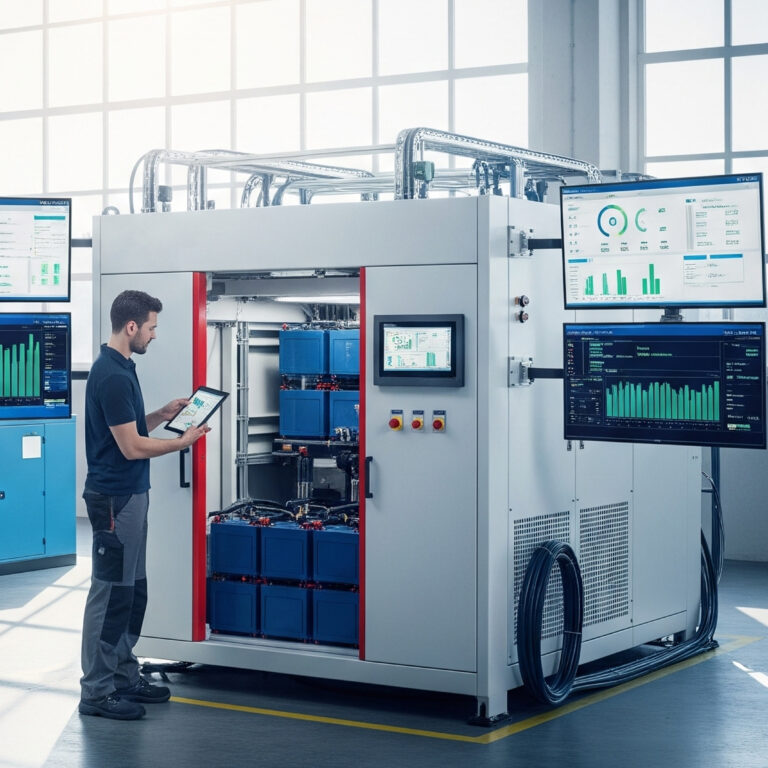
End Layer (IoT Terminal): Advanced sensors track voltage, current, temperature, and cycle count in real time. These smart terminals gather detailed data every 30 seconds, enabling instant detection of anomalies.
Edge Computing: Data is processed locally to identify patterns and take immediate action, minimizing delays and enabling instant decision-making even without cloud connectivity.
Cloud Platform: Centralized intelligence collects data across the entire fleet, applies machine learning algorithms, and delivers predictive insights. Advanced analytics can forecast battery failures up to 48 hours in advance with 95% accuracy.
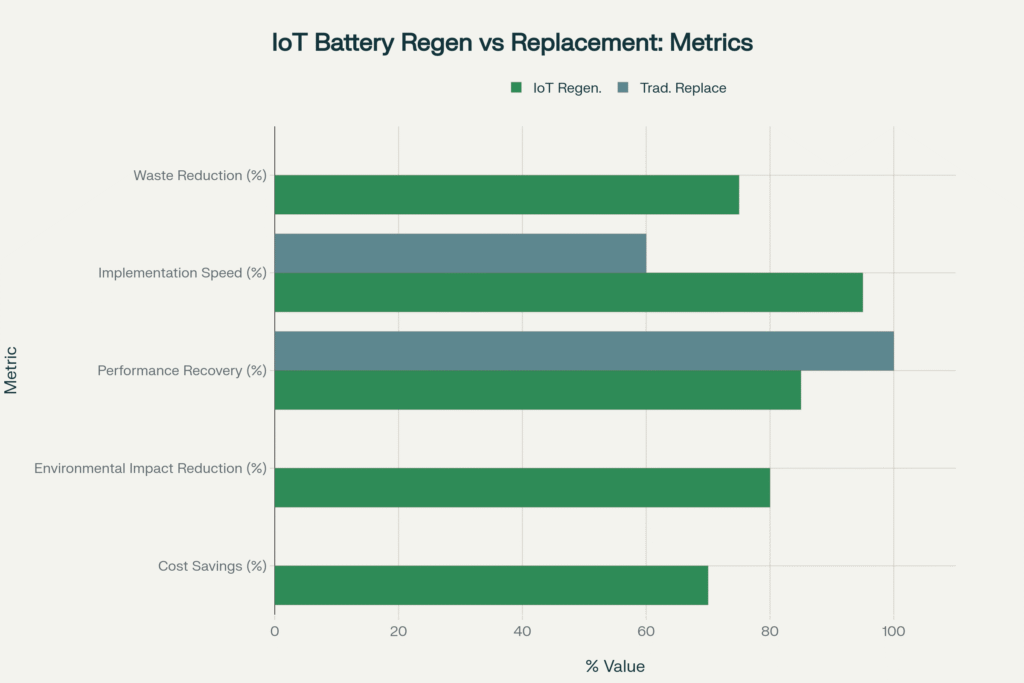
IoT Battery Regeneration vs Traditional Replacement: Comprehensive performance comparison across key sustainability and operational metrics
The Future of Predictive Maintenance
“Machine learning models predict battery health with 30% greater accuracy than traditional methods.”
IoT battery management systems use advanced algorithms to transform maintenance strategies.
Predictive Analytics: Random Forest Regressors and LSTM networks analyze thousands of charge-discharge cycles to detect subtle capacity fade patterns that traditional monitoring methods often miss.
Real-Time Intervention: The system dynamically adjusts charging, balances cells, and plans maintenance according to actual usage instead of preset schedules.
Cost Optimization: Predictive maintenance cuts operational expenses by 20–40% and adds 18–24 months to battery lifespan compared to reactive methods.
Environmental Impact and ESG Excellence
IoT-enabled battery regeneration provides quantifiable environmental gains that align directly with corporate ESG objectives.

Environmental Benefits Distribution of IoT Battery Management Systems showing the proportional impact across key sustainability metrics
Quantified Environmental Benefits
CO2 Reduction: Each regenerated battery avoids up to 200kg of CO₂ emissions, with a carbon footprint that’s 49–54 times lower than manufacturing a new one.
Waste Minimization: IoT-enabled lifecycle management reduces battery waste by 50–80% through optimized usage and accurate end-of-life prediction.
Resource Conservation: Battery regeneration uses 80% fewer raw materials and 77% less energy compared to producing new batteries.
Circular Economy: IoT makes circularity practical by continuously tracking battery health across multiple regeneration cycles—ensuring maximum material utilization and extended lifecycle value.
Full-Stack Asset Management Platform
Modern IoT-driven battery management delivers end-to-end visibility across entire asset portfolios, ensuring every unit is monitored, optimized, and accounted for in real time.
Real-Time Dashboard Analytics
Fleet Overview: Easily monitor hundreds of batteries at once with real-time health status, precise location tracking, and detailed performance trends.
Predictive Insights: AI-driven algorithms accurately forecast remaining useful life, identify the optimal timing for regeneration, and anticipate potential failure modes before they occur.
ESG Reporting: Automated systems generate carbon footprint data, waste diversion metrics, and regulatory compliance documentation, ensuring accuracy and reducing the burden of manual reporting.

IoT battery management dashboard interface displaying real-time monitoring capabilities

ESG Performance Evolution showing the progressive improvement in environmental metrics through IoT battery management implementation over five years
ESG Compliance and Regulatory Alignment
“IoT battery management systems provide audit-ready ESG metrics automatically, ensuring seamless alignment with BRSR requirements and international sustainability standards while reducing reporting complexity.”
IoT platforms simplify ESG reporting by automatically capturing and organizing key sustainability metrics, reducing manual effort and ensuring accuracy for audits and disclosures.
Carbon Footprint Tracking: Real-time tracking of lifecycle emissions, highlighting reductions achieved through regeneration compared to replacement.
Regulatory Compliance: Automated compliance reporting for EU Battery Regulation, Extended Producer Responsibility (EPR), and local sustainability requirements.
Sustainability Metrics: Comprehensive monitoring of Battery Reusability Index (BRI), Lifecycle CO₂ Analysis (LCEA), and Battery Life Extension Rate (BLER).
The Business Case: ROI and Scalability
Immediate Savings: Achieve 65–70% cost savings over battery replacement, with turnaround times as short as 2–3 days.
Operational Excellence: Battery health assessments deliver 99.99% classification accuracy, eliminating false negatives and preventing unnecessary replacements.
Scalable Architecture: A cloud-edge-end architecture manages thousands of batteries across multiple sites, ensuring seamless integration with existing ERP systems.
Future-Ready Technology Stack
Digital Twin Integration: Create virtual replicas of entire battery fleets, enabling advanced simulation, performance forecasting, and optimization.
Blockchain Security: Maintain complete data integrity and end-to-end traceability throughout the entire battery lifecycle.
AI-Powered Optimization: Algorithms continuously evolve by learning from each regeneration cycle, improving the accuracy of future performance predictions.
Conclusion: The Smart Path Forward
“IoT-enabled battery regeneration delivers both sustainability and profitability, giving companies immediate ROI while driving the circular economy of the future.”
The fusion of IoT, machine learning, and battery regeneration unlocks powerful opportunities for businesses to reach peak operational efficiency while fulfilling ambitious ESG commitments. With an estimated 78 million IoT batteries expected to be discarded daily by 2025, intelligent regeneration systems stand out as the only scalable path to truly sustainable battery management.
Companies adopting IoT-enabled battery regeneration achieve measurable gains across sustainability benchmarks: carbon emissions reduced by up to 85%, waste diversion rates reaching 75%, and compliance scores surpassing 95%. By shifting battery management from a cost burden to a strategic asset, this technology drives real environmental impact while ensuring reliable, efficient, and cost-effective operations.
The future will be led by organizations that adopt intelligent asset management. IoT-driven battery regeneration lays the groundwork for this shift, delivering lasting value to businesses, communities, and the environment.